Unravel Quest | NYP Open House 2026
Building The Box of Mischief: How We Led Players to Explore
With five locations for players to traverse weaving them together was a challenge. Here's how Unravel Quest's most ambitious experience yet came to life at Nanyang Polytechnic.
The Problem With Staying Put
Why We Wanted Players to Move
Most of our previous experiences were anchored to a single location. Players arrived, experienced, and left. Contained and manageable. But not quite the vision we had in mind for what Unravel quests could eventually become.
The core ambition was always something more like a journey, an immersive multiplayer adventure where players are led through the world by clues and storytelling, discovering their surroundings as much as they're discovering the narrative. When Nanyang Polytechnic's School of Design & Media invited us to be part of NYP Open House 2026, we had our moment to test that vision at scale.
The brief we gave ourselves was simple: design an experience that spans real physical space, tell a compelling story, and get players to work together.
Design Decisions
Three Guiding Principles
Instead of telling players to go to point A, we used cryptic images and photos to hint at the destination. Figuring out where to go not only challenges their wits but also makes them more aware of their surroundings as they explore.
We introduced collaborative mechanics. We wanted players to genuinely play together, to feel the satisfaction of shared discovery and the joy of working together to complete the puzzles.
Each puzzle would be bespoke, designed specifically for the physical space it lived in. The players had to be at that specific location to figure and solve. The environment would inspire the mechanic, and the mechanic would make players see the environment differently.
Architecture
Solving the Crowd Problem
Five locations across three floors, with one serving as a central hub. That structure gave us range, but it immediately raised a problem we'd seen at other linear adventure experiences: players bunch up. In a fixed narrative sequence, everyone arrives at Puzzle 2 at roughly the same time. Spoilers fly. The sense of discovery collapses.
Our solution was to let the puzzles be completed in any order. The three locks on the Box of Mischief don't care which key you find first. Players could scatter naturally across the building, encounter the puzzles in whatever sequence their curiosity took them, and reconvene with different stories to share. The non-linear structure was an intentional move to give our players the optimal spoiler-free experience.
The Narrative
Agent BB, Toki & The Box of Mischief
Every game needs a reason to move. Ours began at an iconic structure on campus, where players received their mission from Agent BB, their guide. A trickster antagonist named Toki had planted a Box of Mischief somewhere in the building and chained it to the ground with a contraption of their own devising to pull apart the Box of Mischief, unleashing mischief and mayhem to our world. Three locks. Three keys. Somewhere across three floors.
The setup gave us two things simultaneously: a clear objective (find the keys, free the box) and a tone (slightly absurd, playfully adversarial, never threatening). Toki isn't a villain but a puzzle-maker, a mad inventor, someone who hides things in clever places for the joy of watching people find them. That spirit rippled through the entire design.
The Puzzles
Designing for Discovery
The three puzzles were the heart of the build. Each one had to stand alone, feel distinct, and reward a different kind of thinking. Here's how they came together.
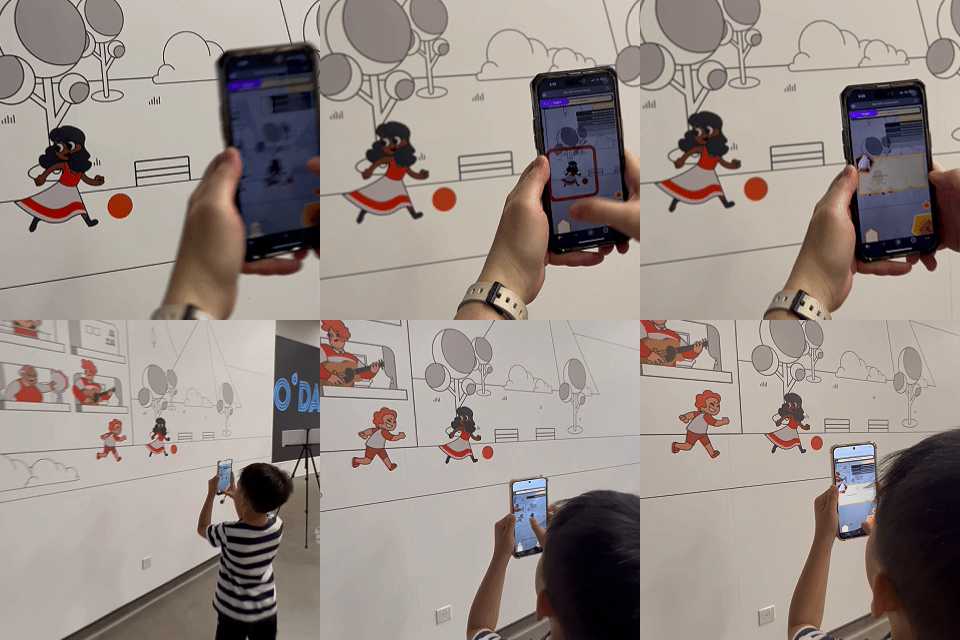
In front of an illustrated mural packed with characters, players figure out who to trade an item with. Each successful exchange yields the next item, until the key eventually appears.
We saw players spread out along the large mural, as they figured out which character to trade with as a team.
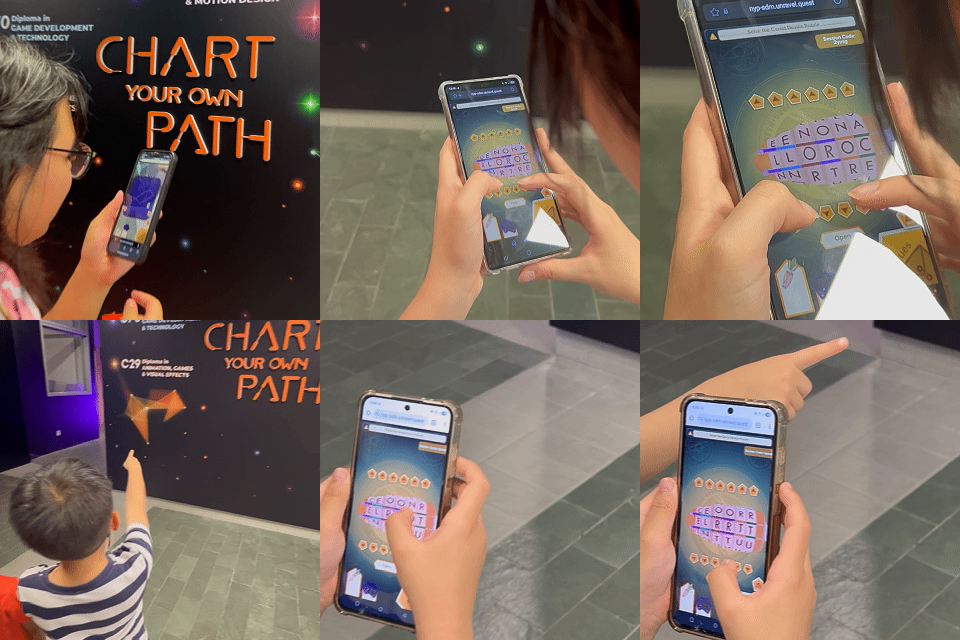
Players receive a lockbox and a set of cards, then navigate to a constellation mural to decode the password.
Players worked as a team, one matching the constellations and the cards, another inputting the code into the lockbox.
A room hidden behind paintings where the key flies around. Players must coordinate, communicate, and work together to trap it.
With solo-play being extra difficult for this puzzle, players worked together to corner the key and capture it.
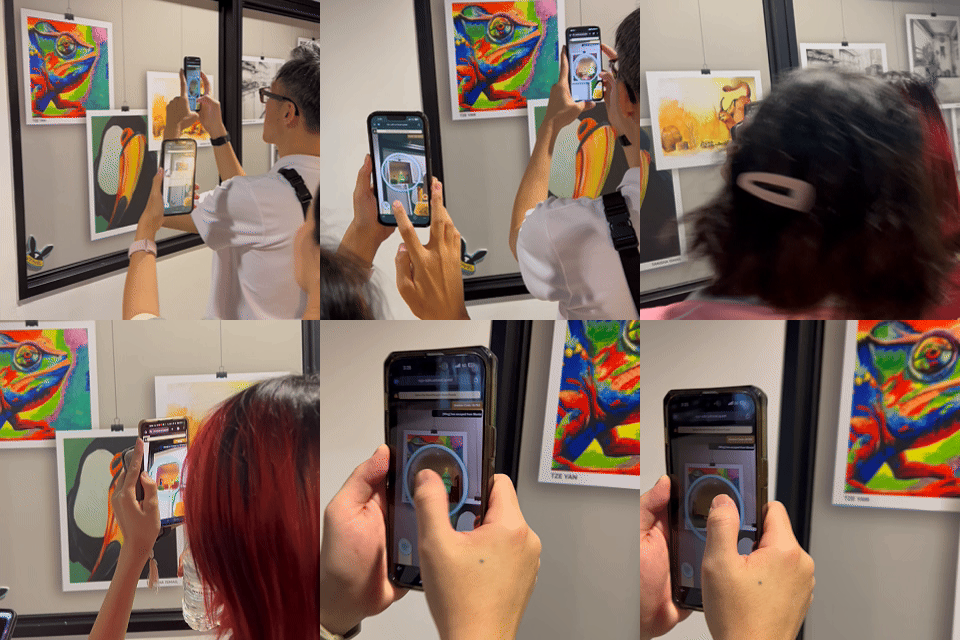
The third puzzle pushed the multiplayer aspect the most. The flying key mechanic forced players to actually talk to each other, to coordinate movement, to feel the payoff of joint effort. That's the kind of moment we wanted more of.
The Payoff
Earning the Badge
Finishing the quest meant carrying the Box of Mischief back to Agent BB at the starting structure mirroring the opening moment. The mission ends where it began.
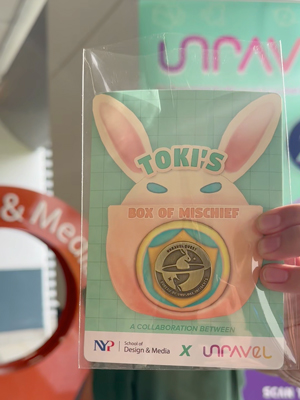
Players received their B.U.N.I. agent badge digitally within the game world. But we wanted something that crossed the boundary between digital and physical, a memento they could bring back home. Complete the end-of-experience survey and players would receive a physical B.U.N.I. badge cementing the memory of the quest they just completed.
Looking Forward
What This Taught Us
The NYP Open House experience was the most spatially ambitious thing we've built under the Unravel banner. It proved that the multi-location format works! Moving players through real physical space, letting them choose their own path through a shared story, creates a fundamentally different energy than a single-stage experience.
The non-linear structure kept groups from colliding and spoiling each other's moments. The collaborative mechanics turned strangers into teammates. And designing each puzzle for its specific environment made the building itself feel like part of the game.
This is what Unravel was always meant to be. We're only getting started.